Robot Drive Systems Explained
How wheels are arranged, powered and steered.

In Robot Locomotion Systems Explained, wheels get a section. They deserve more, because the way they are arranged and steered decides how a robot turns.
Most wheeled robots cannot move straight sideways, because their wheels roll forward and back but resist sliding. Engineers call them nonholonomic (yes, that is a real word). A robot that can move in any direction at any moment is called omnidirectional (Lynch and Park).
Differential drive

A differential-drive robot has two driven wheels on one axis, each with its own motor. A caster or a ball keeps it level. Equal wheel speeds drive the robot straight, and when one wheel runs faster, the robot curves toward the slower side. Run the two in opposite directions and it spins in place.
Lynch and Park name two strengths. The mechanics are simple, since each motor is often fixed straight to its wheel, and the robot is also very manoeuvrable. The weak point is the caster, which is often a poor fit outdoors.
The math is the simplest of any drive here. The forward speed is the average of the two wheel speeds, and the turning speed comes from their difference, as long as the wheels do not slip (ros2_control).
Skid-steer

A skid-steer robot has no steering at all. Four or six fixed wheels, or a pair of tracks, carry the robot, and it turns the way a differential-drive robot does, by running one side faster than the other. Because its wheels cannot point into the turn, they have to skid sideways across the ground to follow a curve (Kozłowski and Pazderski).
That skid is the trade. The frame is simple and rugged, with every wheel driven and nothing to steer, which is why researchers treat skid-steer robots as all-terrain vehicles.
The cost lands on control. How sharply the robot turns depends on the grip between its wheels and the ground, and grip changes with the surface, so a controller has to cope with ground forces it cannot know in advance. On top of that, counting wheel turns assumes the wheels do not slip, so it misjudges how far a skid-steer robot has turned.
Ackermann steering

Ackermann steering is how a car turns. The rear wheels are fixed and the front wheels steer. In a turn, the inner front wheel steers more sharply than the outer one, so every wheel rolls around the same centre point without sliding (Lynch and Park, ros2_control).
Because no wheel has to skid, an Ackermann robot rolls cleanly through a turn. The limit is the turning circle. An Ackermann robot cannot turn in place, so it needs room to turn around and sometimes a three-point turn. Navigation software has to plan for that.
Nav2 is the open-source navigation software for ROS 2, the Robot Operating System. In one of its path-following controllers, the Ackermann model has a minimum turning curvature, whereas the differential and omnidirectional models do not (Nav2).
Mecanum and omni wheels

Omni wheels and mecanum wheels carry small, free-spinning rollers around their rims. On an omni wheel, the rollers' axles run around the rim at right angles to the wheel's own axle. That lets the wheel drive forward and back while sliding freely sideways. On a mecanum wheel, the rollers are set at an angle, typically 45 degrees (Lynch and Park). Bengt Ilon invented the mecanum wheel in Sweden, and his patent was published in 1975 (Ilon).
Neither wheel steers. Each one is only driven forward or back, and the robot's motion comes from the mix of all of them. Each wheel runs at its own speed and direction, so the robot can slide straight sideways, move diagonally or spin. Common layouts are three omni wheels in a triangle and four mecanum wheels on a rectangle.

The catch is the ground. The rollers are small, which is why these wheels work best on hard, flat floors (Lynch and Park). They are at home on a factory floor or in a lab, where sliding sideways into a tight spot is worth a great deal, though on a sidewalk it is worth much less.
Swerve drive

A swerve drive puts a wheel that is both driven and steered at each corner. The control software takes a forward speed, a sideways speed and a turning speed. It turns them into a speed and an angle for every wheel module (WPILib).
Each module reverses its speed when that saves it a long turn, so the wheel needs to turn less (WPILib).
The cost lands on planning. A robot with four independently steered wheels has more actuators than it needs, and its wheels may not be able to make full turns. Those limits split its motion into regions. Crossing from one to the next may mean stopping to reposition the wheels (Liu and colleagues).
How to choose
Each drive suits the ground and the space more than the job.
| Drive | Turns in place | Moves sideways | Build | Control |
|---|---|---|---|---|
| Differential drive | Yes | No | Two motors, simple | Simple |
| Skid-steer | Yes, by skidding | No | Rugged, every wheel driven | Hard: turns depend on grip |
| Ackermann steering | No, it needs a turning circle | No | A steering linkage | Plans around the turning circle |
| Mecanum wheels | Yes | Yes | Four roller wheels | Moderate |
| Omni wheels | Yes | Yes | Three roller wheels | Moderate |
| Swerve | Yes | Yes | A drive and a steering motor at every wheel | Hardest: wheel limits split the motion |
- Differential drive suits smooth indoor floors, where two motors and a turn on the spot are enough.
- Skid-steer suits mixed outdoor ground, where a rugged frame is worth the slip in turns.
- Ackermann steering suits robots that cover distance on paved ground with room to turn.
- Mecanum and omni wheels suit hard flat floors in tight spaces, where moving sideways saves time.
- Swerve suits a robot that needs to move in any direction on a firm floor and can pay for the parts.
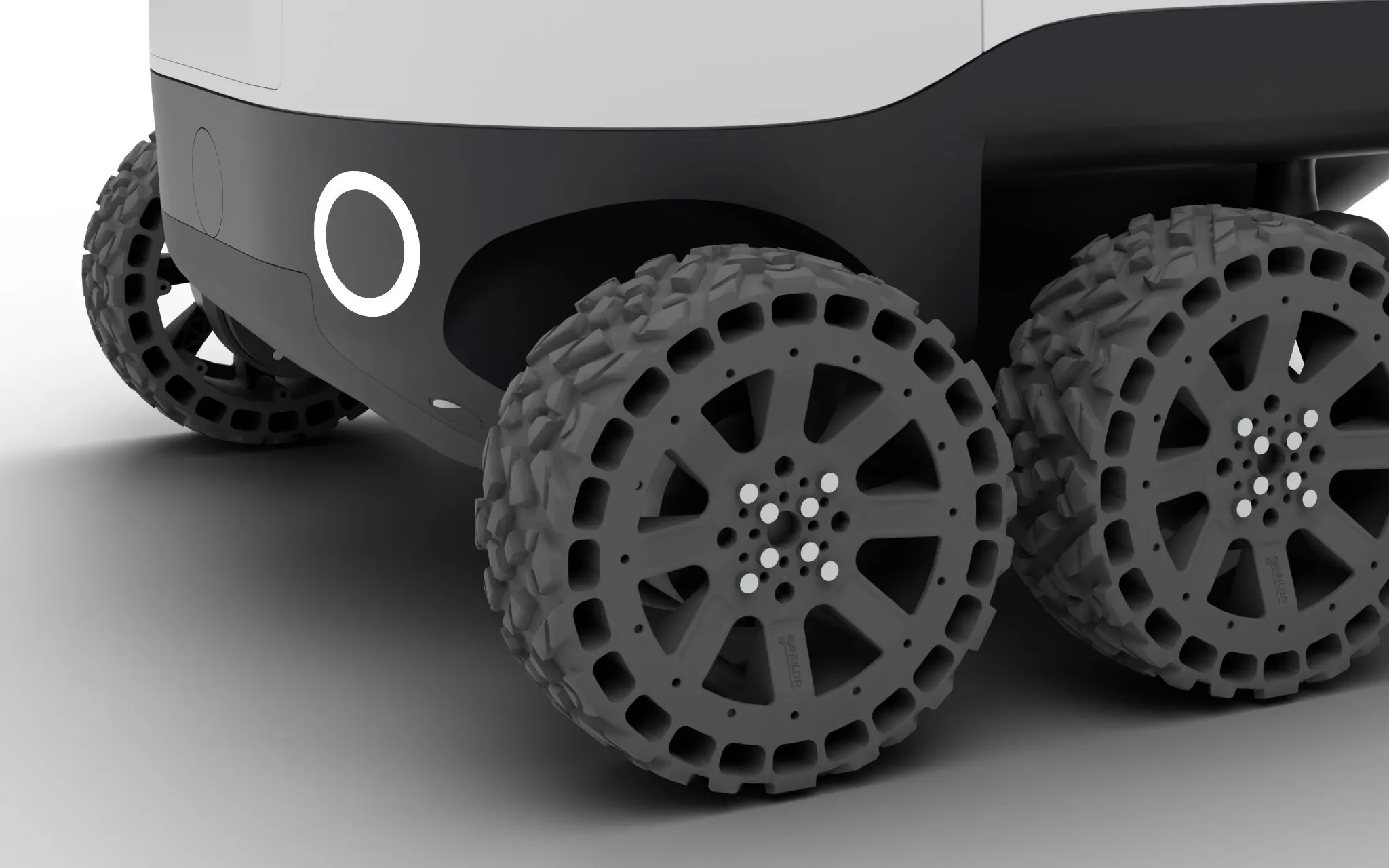
Our own courier has six driven wheels and turns the skid-steer way. How its wheels follow the ground is the subject of Robot Suspension Explained.